You found the house.
You made an offer.
The seller accepted.
Congratulations! You’re officially under contract.
Now comes the part where everybody starts throwing around phrases like due diligence, earnest money, contingencies, and binding agreement date.
And you’re standing there thinking:
“I just wanted to buy a house. Why does this suddenly feel like I’m studying for the bar exam?” 😂
Welcome to real estate.
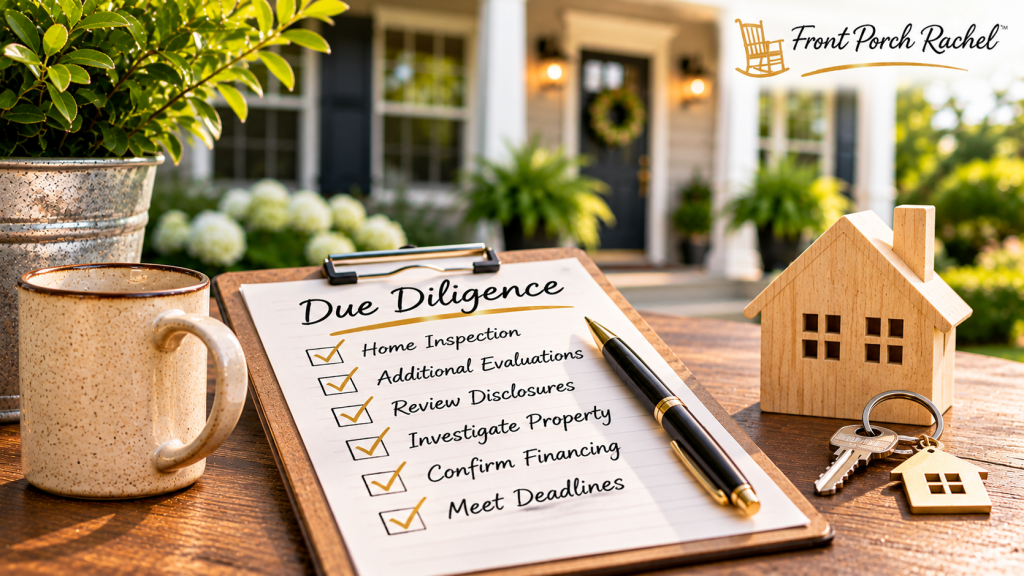
One of the most important things Georgia homebuyers need to understand is the due diligence period.
Because what you do during those few days can make a very big difference in your purchase.
Let’s talk about what it means, what you should be doing, and why I get a little twitchy when buyers start approaching their deadlines.
First, What Is Due Diligence?
In many Georgia residential purchase agreements, the buyer and seller negotiate a period of time called the due diligence period.
Think of it as your opportunity to investigate the property before fully committing to moving forward.
During this time, you can learn more about the house, evaluate potential problems, and decide whether purchasing it still makes sense.
Under the commonly used Georgia Association of REALTORS® purchase agreement, when the applicable due diligence provision is selected, the buyer generally has the right to terminate during that period for any reason or no stated reason, provided the buyer follows the contract’s notice requirements.
That’s a significant protection.
But here’s the important part:
Due diligence isn’t automatic in every Georgia contract.
The agreement must provide for it, and the terms matter.
And it definitely doesn’t last forever.
How Long Is the Due Diligence Period in Georgia?
There’s no universal rule that every Georgia buyer automatically gets seven, ten, or fourteen days.
The length is negotiated between the buyer and seller.
Depending on the transaction, the period might be several days or longer.
And in a competitive situation, a buyer might agree to a shorter period—or even purchase without a due diligence period.
That’s why you need to understand what you’re agreeing to before submitting an offer.
Here’s something else.
Contract deadlines are not suggestions.
If your due diligence period expires at a specific date and time, you need to complete your investigation and make any required decisions before that deadline.
Not the next morning.
Not after lunch.
And not whenever your cousin finally gets around to looking at the inspection report.
Because Cousin Eddie might know a lot about plumbing, but he does not get to extend your real estate contract. 😂
What Should You Do During Due Diligence?
This is where the work begins.
Your due diligence period isn’t simply time to sit around admiring the listing photos and picking out paint colors.
It’s your opportunity to investigate the property.
Here are some of the things I encourage buyers to consider.
1. Schedule Your Home Inspection
This is usually one of the first things we want to accomplish.
A home inspector evaluates the property’s visible and accessible systems and components and identifies concerns that may need attention.
That might include:
- Roofing
- Electrical systems
- Plumbing
- Heating and cooling
- Foundation and structural components
- Attic and crawlspace conditions
- Moisture intrusion
- Windows and doors
- Safety concerns
And yes, sometimes the report is approximately 847 pages long.
Or at least it feels that way. 😂
Here’s what I remind buyers:
An inspection report is not a list of everything the seller is automatically required to repair.
It’s information about the property’s condition.
We use that information to decide what matters, what may require further evaluation, and whether to negotiate with the seller.
If the inspection uncovers problems, we’ll look at which issues deserve further evaluation, which repairs may be worth negotiating, and how those concerns affect your decision to move forward.
Because here’s the thing: not every inspection finding is a dealbreaker, but some deserve serious attention before your due diligence period expires.
The goal isn’t to find a house without a single problem. It’s to understand what you’re buying and make an informed decision.
2. Consider Additional Inspections
A general home inspection is important, but it doesn’t necessarily cover everything.
Depending on the property, you may want additional evaluations.
For example:
Septic system: If the house has a septic system, consider an appropriate inspection.
Well water: For properties with private wells, water quality testing and system evaluations may be important.
Termites and wood-destroying organisms: Georgia homeowners know these little freeloaders can cause expensive problems.
Radon: Testing may be worth considering.
Sewer line: A sewer scope can identify certain underground drainage problems.
Structural concerns: An engineer or other qualified specialist may be needed.
Moisture or suspected mold: Further investigation may be appropriate.
Not every house needs every possible specialist.
But if something concerning comes up, we need enough time to investigate it.
Because the last thing I want is a buyer discovering an expensive problem after closing and saying:
“Well, nobody told me I should check that.”
3. Review the Seller’s Disclosures
If the seller provides a property disclosure statement, read it carefully.
I mean actually read it.
Not just scroll to the signature line and click the button.
The disclosure may contain information about known issues, repairs, systems, water intrusion, insurance claims, or other property conditions.
It isn’t a substitute for an inspection.
And it isn’t a guarantee that every possible problem has been identified.
But it can help you understand the property’s history and decide whether anything needs additional investigation.
If something doesn’t make sense, ask questions.
That’s what this period is for.
4. Investigate the Property Beyond the House
This is particularly important for buyers purchasing acreage or homes in rural areas around Bartow County.
You may love the house.
You may love the land.
You may already be imagining your chickens, workshop, camper, and a garden big enough to feed half the county.
Wonderful.
But first, we need to find out what you’re actually allowed to do.
Depending on the property, you may need to investigate:
- Zoning and permitted uses
- Deed restrictions
- HOA rules
- Easements
- Property boundaries
- Legal access
- Flood zones
- Utilities
- Internet availability
- Nearby development plans
I’ve talked about this in Before You Buy the Acreage: What Can You Actually Do With the Property?.
And if you’ve never dealt with easements before, my article What Is an Easement—and Why Should Bartow County Homebuyers Care? explains why they matter.
Because buying five acres doesn’t automatically mean you can build anything you want on those five acres.
Even if the listing says “ENDLESS POSSIBILITIES!”
Sometimes the possibilities have zoning restrictions. 😂
5. Understand the Neighborhood
A home doesn’t exist in a vacuum.
You’re also purchasing a location.
And that location can affect your daily life just as much as the house itself.
Drive through the neighborhood.
Check your commute during the hours you’ll actually be traveling.
Look into nearby roads, traffic patterns, and future development.
Research school assignments if they’re important to your decision.
Consider noise, access, and nearby land uses.
And if you’re moving to Northwest Georgia from somewhere else, spend time getting familiar with the different communities.
A house in downtown Cartersville and a property outside Taylorsville can offer very different lifestyles.
Neither is automatically better.
But one may be a much better fit for you.
6. Evaluate Repair Requests and Negotiations
Let’s say the inspection identifies several issues.
Now what?
Depending on the contract and the circumstances, you might request repairs, negotiate other terms, accept the property in its current condition, or exercise a valid termination right.
But here’s something buyers need to remember:
The seller does not automatically have to agree to your repair requests.
And simply sending a repair request does not necessarily extend your due diligence deadline.
That’s an important distinction.
If the seller hasn’t agreed to repairs and your due diligence period is about to expire, you need to understand your options before the deadline passes.
Any negotiated changes should be properly documented in writing.
A verbal promise that somebody will take care of something later is not how I want to handle an important contractual issue.
7. Keep Your Lender Involved
Due diligence isn’t just about the physical property.
You also need to keep your financing moving.
Make sure your lender has the documents they need.
Respond to requests.
Ask questions about your loan program.
And if something changes financially, tell your lender immediately.
But don’t confuse the due diligence period with your financing contingency.
They are separate contractual protections with potentially different requirements and deadlines.
Your lender may still be working through underwriting after due diligence ends.
That doesn’t automatically extend your right to terminate for any reason.
And while we’re discussing financing…
Please don’t celebrate getting under contract by financing a new vehicle.
I promise the dealership will still have cars after closing. 😂
For a breakdown of the expenses involved in purchasing a home, see How Much Money Do You Actually Need to Buy a House in Georgia?.
What Happens If You Find a Serious Problem?
This is one of the biggest reasons due diligence matters.
Let’s say your inspector discovers a major foundation concern.
Or there’s significant water intrusion.
Or the septic system needs expensive work.
You may have several possible paths, depending on your contract.
You might negotiate with the seller.
You might obtain estimates or additional evaluations.
You might decide the problem is manageable.
Or you might decide the property isn’t the right purchase for you.
If you have a valid due diligence termination right and exercise it properly before the deadline, you may be able to terminate without the same consequences that could arise from defaulting after that protection expires.
But you must follow the actual contract.
I explain this more fully in Can a Buyer Back Out of a Real Estate Contract in Georgia?.
What Happens to Earnest Money During Due Diligence?
Earnest money is one of the biggest concerns buyers have when they’re considering terminating a contract.
And understandably so.
Nobody wants to lose thousands of dollars.
Under a contract that provides an applicable due diligence termination right, a buyer who properly terminates within that period will generally be entitled to the return of earnest money, subject to the contract’s terms.
But there are two things to understand.
First, the termination must be handled correctly.
Second, terminating the agreement and disbursing earnest money may involve separate procedures.
You shouldn’t assume the money automatically returns to your account the moment a termination notice is delivered.
Also, don’t confuse earnest money with any separate due diligence payment or other nonrefundable consideration specified in a particular contract.
Those terms can affect what money is recoverable.
The details matter.
What Happens When Due Diligence Ends?
Once the due diligence period expires, the buyer generally loses the broad termination right associated with that provision.
That doesn’t necessarily mean the buyer has no remaining contractual protections.
Other contingencies may still apply.
But the buyer usually cannot simply decide they don’t like the house anymore and expect to walk away without consequences.
This is why I want buyers to make informed decisions while their contractual options are still available.
Because after the deadline, the conversation can change considerably.
Can You Extend the Due Diligence Period?
Sometimes.
But it requires agreement between the parties and proper documentation.
A buyer cannot simply announce:
“We’re going to need three more days.”
And assume the seller has to agree.
If an extension is necessary, it should be negotiated and documented before the existing deadline expires.
That’s why I like to schedule inspections early.
Waiting until the final day to inspect the property doesn’t leave much room for additional evaluations or negotiations.
And I prefer my real estate transactions with as little last-minute chaos as possible.
We have enough excitement already.
My Advice to Georgia Homebuyers
If you’re buying a house, don’t treat due diligence as a technicality.
Use the time wisely.
Get the inspections scheduled.
Read the documents.
Investigate the property.
Ask questions.
Understand your deadlines.
And communicate concerns as soon as they come up.
You don’t have to know everything about houses.
That’s why you hire qualified professionals to help evaluate them.
But you do need to understand the decisions you’re making.
The Front Porch Take
The due diligence period is one of the most valuable protections a Georgia buyer may negotiate.
It’s your opportunity to look beyond the pretty photographs and understand the property you’re purchasing.
Because that gorgeous kitchen doesn’t tell you anything about the crawlspace.
And those beautiful hardwood floors aren’t going to explain the septic system.
The goal isn’t to find a perfect house.
I’ve been selling real estate long enough to tell you that perfect houses are pretty elusive.
The goal is to understand what you’re buying, what you’re comfortable accepting, and what risks you’re taking on.
Then you can make an informed decision.
Because getting the keys is exciting.
Knowing what you’re getting with those keys is even better.
Real Estate. Real Life. Rachel.
This article provides general information and is not legal advice. Contract rights, deadlines, and termination requirements depend on the specific agreement. Consult a Georgia real estate attorney when legal guidance is needed.
Front Porch Rachel | RE/MAX Pure | Realtor®


Leave a Reply