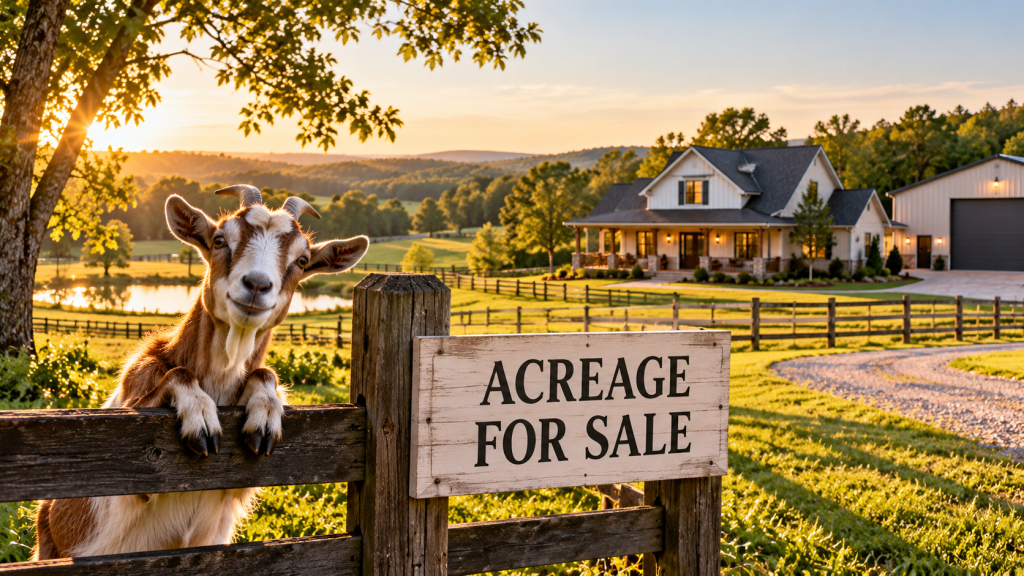
You found it.
Five acres.
Trees.
Privacy.
No neighbor close enough to know when you take the trash out in your pajamas.
And suddenly you’re planning your entire new life.
There’s going to be a workshop.
An RV.
Maybe some chickens.
A garden.
A pool.
A second house for your mother.
And apparently a goat named Kevin has entered the conversation.
😂
I support the dream.
But before you buy the acreage, we need to answer one very important question:
Can you actually do all of those things on this particular property?
Because owning several acres does not automatically mean:
“It’s my land. I can do whatever I want.”
Especially when you’re buying property in Bartow County.
Acreage and Freedom Are Not the Same Thing
This surprises buyers.
A property can feel extremely rural and still have restrictions on how it can be used.
The number of acres tells us the size of the property.
It doesn’t necessarily tell us:
- How the property is zoned
- What structures can be built
- Whether animals are permitted
- Whether the property can be divided
- Where additional structures can be placed
- Whether an RV can be stored or occupied there
- Whether a business can operate there
- Whether there’s an HOA
- Whether private covenants exist
- Whether easements affect the property
- Whether septic limitations affect future plans
So when a buyer tells me:
“I want at least five acres.”
My next question is:
“What do you want to do with the five acres?”
Those are two completely different searches.
Start With the Dream
Before we ever start evaluating restrictions, tell me what you’re imagining.
Do you want:
Chickens?
Horses?
Goats?
A detached garage?
A large workshop?
RV storage?
A camper hookup?
A pool?
A guest house?
A second home for family?
A home-based business?
A barn?
A shooting range?
Subdivision potential someday?
Space to store work equipment?
A tiny house?
Because if one of those things is a major reason you’re buying acreage, it needs to become part of our property research before you close.
Not after.
I don’t want you calling me six months later saying:
“Rachel, apparently I can’t build the shop.”
And me saying:
“Remember when I kept asking what you planned to do with the land?”
😂
Let’s have that conversation now.
Check the Zoning
This is one of the first places we start.
Bartow County maintains zoning districts with different permitted uses and development standards. The county’s zoning ordinance addresses everything from residential and agricultural uses to accessory structures, animals, home occupations and other land uses.
But here’s the part I want buyers to understand:
Do not assume zoning from what the property looks like.
A house surrounded by woods isn’t automatically agricultural.
A property with a barn doesn’t automatically mean you can build another one.
And the fact that the neighbor has six goats does not automatically grant Kevin legal residency.
😂
We verify the zoning for the actual parcel.
Is the Property Inside City Limits?
This matters too.
A Bartow County mailing address doesn’t necessarily tell us which government has jurisdiction over the property.
A property may be inside one of Bartow County’s municipalities—or it may be in unincorporated Bartow County.
That can affect which zoning ordinance, permitting department and other regulations apply.
So before we start interpreting what the property can be used for, we need to know:
Who actually governs it?
City?
County?
And sometimes the answer isn’t obvious from the mailing address.
“But There Isn’t an HOA.”
Wonderful.
That eliminates one potential layer of restrictions.
It does not mean:
No rules.
😂
This is a big misconception with rural property.
You may have no HOA whatsoever and still have:
- County zoning requirements
- Building codes
- Setback requirements
- Septic requirements
- Easements
- Recorded covenants
- Environmental limitations
- Utility easements
- Road-access issues
No HOA means you don’t have an HOA.
That’s it.
It is not a governmental hall pass.
Can You Build a Detached Garage or Workshop?
Maybe.
And for many acreage buyers, this is a big deal.
You may be imagining:
A woodworking shop.
A mechanic’s garage.
A place for the boat.
A giant building for your husband’s collection of things he insists are absolutely necessary.
😂
But before assuming we can put a 40-by-60 building wherever we want, we need to investigate things like:
- Zoning
- Permitted accessory structures
- Setbacks
- Lot coverage
- Building permits
- Septic location
- Easements
- Utilities
- Terrain
- Recorded restrictions
Even if the structure itself is permitted, the location you imagined for it may not work.
Which brings me to something buyers overlook constantly…
Where Is the Septic System?
If the property isn’t served by public sewer, this matters enormously.
The septic tank and drain field occupy real space.
And that space may interfere with the future pool, garage, addition or second dwelling you already mentally built while standing in the backyard.
😂
Before making major future plans, you need to understand where the existing septic components are located and what additional septic approval might be required for future development.
“There’s plenty of land” doesn’t automatically mean every acre is buildable.
Can You Build Another House?
This comes up constantly with acreage.
Maybe you want:
A house for your parents.
A house for an adult child.
A guest cottage.
An income-producing second residence.
Or you’re thinking:
“Someday we could split this and sell part of it.”
Maybe.
But that’s something we investigate rather than assume.
Lot size, zoning, road frontage, access, utilities, septic suitability, subdivision requirements and other development standards can all affect what’s possible.
Five acres on paper does not automatically equal:
House + House + Barn + Pool + Kevin’s private goat residence.
😂
What About Chickens, Horses or Other Animals?
This is where rural buyers get particularly excited.
And I understand.
You finally have land.
You have watched three homesteading videos.
You now own overalls.
Things are escalating quickly.
😂
But livestock and animal rules can depend on the property’s zoning, acreage and specific use.
Bartow County’s zoning ordinance contains provisions addressing animals and livestock in different circumstances.
So if having chickens, horses, goats or other animals is important to you, tell me before we buy the property.
We’re going to verify whether your intended use works.
Kevin deserves certainty too.
Can You Park an RV There?
Another common acreage assumption:
“There’s no HOA, so of course I can park my RV here.”
Maybe.
But again, storage and occupancy are two different questions.
Keeping an RV on your property may be treated differently from:
Living in it.
Connecting utilities to it.
Using it as guest quarters.
Allowing someone else to occupy it long-term.
The same goes for campers and tiny homes.
If that’s part of your plan, we research the rules that apply to the parcel.
What About Running a Business From the Property?
This is a big one.
Maybe you want a home office.
Probably straightforward.
Maybe you want customers coming to the property.
Employees.
Equipment.
Trailers.
Inventory.
Commercial vehicles.
A workshop.
Now we’ve changed the conversation.
Bartow County’s zoning ordinance includes standards for home occupations, and the type and intensity of the business can matter.
Don’t assume that because you own the land, you can automatically operate any business you want from it.
If the business is part of the reason you’re moving, it belongs on our due-diligence list.
Easements Can Change the Picture
You may own five acres.
But someone else may have a legal right to use part of it.
Common examples include:
- Utility easements
- Access easements
- Shared driveways
- Drainage easements
- Private-road easements
An easement doesn’t automatically make a property undesirable.
They’re incredibly common.
But you should understand where they are and what they allow before you start planning structures, fences or other improvements.
And yes, we have an entire article coming for this one because easements deserve their own conversation.
Look at the Actual Land, Not Just the Acreage Number
This is something I really want acreage buyers to understand.
Five acres can look very different from property to property.
One may be:
Mostly level.
Open.
Usable.
Easy to access.
Another five-acre parcel may be:
Steep.
Heavily wooded.
Crossed by a creek.
Affected by easements.
Mostly behind the house.
Or shaped like somebody drew the property line during an earthquake.
😂
Both listings say:
5 acres.
Your ability to actually use those acres may be completely different.
Don’t Forget Road Access
How do you get to the property?
County-maintained road?
Shared driveway?
Recorded easement?
If you’re planning to build a large shop, bring equipment onto the property or potentially develop part of the land later, access becomes even more important.
Utilities Matter More Than You Think
Especially once you leave the subdivision.
Ask:
Is there public water?
A well?
Public sewer?
Septic?
Natural gas?
Propane?
What internet providers serve the property?
Where are electrical lines located?
If you’re planning another structure, can utilities reasonably reach it?
A detached shop becomes considerably less exciting when you discover getting power to it requires selling one of your children.
😂
Don’t Rely on the Listing Description
If an MLS listing says:
“Perfect for horses!”
Lovely.
We’re still verifying it.
If it says:
“Plenty of room to build another home!”
Great.
We’re still verifying it.
If it says:
“No restrictions!”
You already know what I’m about to say.
😂
We’re still verifying it.
Marketing language is not the same thing as governmental approval, a title examination or professional land-use advice.
If a particular use is important to you, we go to the appropriate source and confirm it.
Who Should You Ask?
Depending on what you’re planning, that might include:
- Bartow County Community Development
- The applicable city planning/zoning department
- Environmental health regarding septic
- A surveyor
- Your closing attorney/title professional
- Utility providers
- Your lender
- Your insurance professional
- A contractor or engineer
- Other appropriate specialists
Your Realtor helps identify the questions and coordinates the investigation.
But I am not going to stand in a pasture, squint thoughtfully toward the property line and declare:
“Yep. Pretty sure you can build another house right there.”
😂
We verify.
Put Your Plans on the Due-Diligence List
This is probably the most important takeaway.
Don’t just inspect the house you’re buying.
Investigate whether the property supports the life you’re planning.
If the workshop is non-negotiable:
Verify it.
If the horses are non-negotiable:
Verify it.
If Mom’s future cottage is non-negotiable:
Verify it.
If you’re buying the property specifically because you want to run your business there:
Definitely verify it.
Because finding out before closing may be mildly disappointing.
Finding out after closing can be extremely expensive.
A Front Porch Rachel Thought
I love acreage.
There’s something about standing on a piece of land and realizing:
This could all be mine.
And immediately your imagination starts filling in the blanks.
The garden goes there.
The shop goes there.
The pool goes there.
We’ll put Mom over there.
Chickens somewhere behind the barn.
Kevin can wander around doing whatever goats do all day.
😂
That’s part of the fun.
But before we buy the dream, I want to make sure the property can actually support it.
Because the right acreage isn’t simply:
How many acres are there?
It’s:
Can you use those acres the way you want to live?
That’s the question worth answering before you sign at the closing table.
Real Estate. Real Life. Rachel.


Leave a Reply