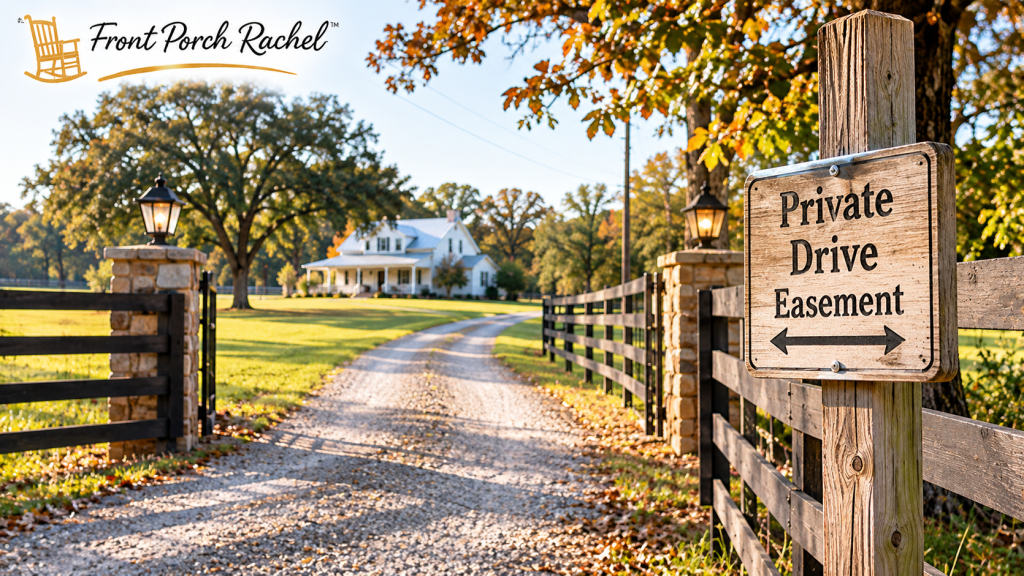
You’ve found the house.
It has the perfect kitchen, a beautiful backyard, and enough room for the workshop you’ve been dreaming about.
Maybe there’s even a little acreage.
You’ve already decided where the garden is going, where you’ll park the camper, and whether the chickens should have their own little house.
Then somebody mentions an easement.
And you’re thinking:
“A what?”
Welcome to one of those real estate terms that sounds complicated but is actually pretty important.
Especially if you’re buying property in Bartow County, Georgia, where rural acreage, shared driveways, and utility easements aren’t unusual.
Let’s talk about what an easement is, why it matters, and what you should investigate before buying a property.
First, What Exactly Is an Easement?
An easement is a legal right that allows someone to use another person’s property for a specific purpose.
Here’s a simple example.
You own five acres.
But the electric company has an easement across part of your land to access and maintain power lines.
You still own the property.
You can still use it, subject to the easement’s terms.
But you may not be able to build certain structures or plant certain trees within that easement area.
And the utility company may have the right to enter that portion of the property to maintain its equipment.
You own the land, but someone else has certain legal rights to use part of it.
That’s the basic idea.
And easements can exist on everything from small subdivision lots to large rural properties.
Common Types of Easements in Georgia
Not all easements are the same.
Here are several types buyers may encounter.
1. Utility Easements
These are probably some of the most familiar.
Utility easements may allow companies or public entities to install, access, repair, or maintain infrastructure such as:
- Electric lines
- Water lines
- Sewer lines
- Gas lines
- Telecommunications equipment
- Underground utilities
You may not even notice a utility easement when you’re touring a property.
But it could affect where you’re allowed to build a fence, install a pool, add a shed, or plant trees.
And here’s the thing:
Just because the land looks empty doesn’t mean it’s available for whatever you want to put there.
Which is disappointing when you’ve already mentally ordered the 24-by-30 workshop. 😂
2. Access Easements and Shared Driveways
These are particularly important when buying rural property.
Imagine there’s a house sitting behind another property.
The only practical way to reach that house is by traveling across a driveway located on the neighboring parcel.
There may be an access easement giving the rear property owner the legal right to use that driveway.
But here’s where things get interesting.
Who maintains the driveway?
Who pays for repairs?
Can the driveway be widened?
Can either owner install a gate?
Can the easement be used for additional homes or other purposes?
Those answers depend on the specific legal rights involved.
And they should be investigated before closing.
Because nothing says “Welcome to your new home!” quite like discovering you and your neighbor disagree about who is responsible for maintaining a quarter-mile gravel driveway.
3. Drainage Easements
A drainage easement may allow stormwater to flow through a designated portion of a property or permit access to maintain drainage infrastructure.
This can matter if you’re planning landscaping, grading, fencing, or construction.
For example, you may have a large backyard that looks perfect for a pool.
But if the area is subject to a drainage easement, your plans could be restricted.
And drainage easements deserve attention for another reason.
Water doesn’t particularly care where your property lines are.
Understanding how water moves across a property is important, especially when you’re considering construction or improvements.
4. Conservation Easements
A conservation easement is generally intended to protect certain natural, agricultural, historic, or environmental characteristics of a property.
Depending on its terms, it may limit development, subdivision, land clearing, or other activities.
These can be especially relevant when purchasing larger parcels.
And unlike some restrictions that affect only a small strip of land, a conservation easement may apply to a substantial portion of a property.
If you’re buying acreage with plans to build, divide, or develop it, this is something you absolutely want to understand.
Does an Easement Mean Someone Else Owns Your Land?
Usually, no.
An easement generally gives someone a limited right to use another person’s property.
It doesn’t ordinarily transfer ownership of the land itself.
But that doesn’t mean you can ignore it.
Depending on how the easement was created, it may remain in effect when the property changes ownership.
So buying a house doesn’t necessarily make an existing easement disappear.
And neither does putting up a fence.
I know.
Wouldn’t that be convenient? 😂
Can an Easement Affect What You Can Build?
Absolutely.
And this is one of the biggest reasons I want buyers to understand easements before purchasing property.
Let’s say you’re buying a house with a large backyard.
You want to add:
A swimming pool.
A detached garage.
A workshop.
A fence.
Maybe even a guesthouse.
But there’s a utility easement running through the area where you want to build.
Depending on the easement’s terms and applicable requirements, your plans may need to change.
And remember, easements aren’t the only restrictions that matter.
Zoning, setbacks, deed restrictions, HOA requirements, septic locations, and permitting rules may also affect what you can do.
This is why I always encourage acreage buyers to investigate their plans before purchasing.
For more on that, read [Before You Buy the Acreage: What Can You Actually Do With the Property?]
Because “five beautiful acres” and “five acres where you can build everything you’ve imagined” are not necessarily the same thing.
What If Your Neighbor Has Been Using Your Property for Years?
Now we’re getting into an area that can become legally complicated.
Georgia law recognizes circumstances in which private rights of way may arise through long-term use, sometimes called prescriptive rights.
But that doesn’t mean your neighbor automatically acquires an easement simply because they’ve been driving across your land for years.
Georgia has specific legal requirements involving the type of land, duration of use, and other circumstances.
These situations are fact-specific.
If there’s a question about whether someone has acquired a legal right to use part of a property, that’s a conversation for a qualified Georgia real estate attorney.
Not a Facebook neighborhood group.
And definitely not the neighbor who announces:
“Well, my granddaddy’s been driving through here since 1962!”
That might be relevant information.
It is not, by itself, a complete legal analysis. 😂
How Do You Find Out If a Property Has an Easement?
This is where due diligence becomes important.
Depending on the property, easement information may appear in several places.
The Deed and Recorded Documents
Some easements are established through recorded legal documents.
A title examination may identify recorded easements affecting the property.
But buyers should understand that not every possible property-use issue is necessarily obvious from a deed or title search alone.
The Survey or Recorded Plat
A survey may show the location of certain easements, access roads, encroachments, and other features affecting the property.
A recorded subdivision plat may also identify easement areas.
For buyers planning improvements or purchasing acreage, a current survey can be particularly valuable.
And no, the aerial property lines on your favorite real estate website are not a substitute for a professional survey.
Those lines can be useful for general reference.
They are not necessarily precise legal boundaries.
The Closing Attorney
In Georgia, the closing attorney plays an important role in the real estate transaction.
If an easement appears in the title examination or other property documents, ask questions about what it means.
What rights does it grant?
Who benefits from it?
Does it affect access?
Could it interfere with your intended use?
If the issue requires legal interpretation, the closing attorney or another Georgia real estate attorney can help you understand the implications.
The Appropriate Local Government or Utility Provider
Depending on the question, county or municipal planning departments, utility providers, or other agencies may have relevant information.
But remember:
An easement and a zoning restriction are not the same thing.
You may need to investigate both.
What About Property That Doesn’t Have Direct Road Access?
This is a big one.
Especially when you’re looking at acreage.
A property may appear to have a driveway or a road leading to it.
But that doesn’t automatically establish that the property has legally enforceable access.
If access crosses land owned by someone else, you need to understand the legal arrangement.
Is there a recorded easement?
What property benefits from it?
Where is it located?
What uses are permitted?
Are there maintenance obligations?
Does the access meet applicable requirements for your intended use?
And if you’re planning to build a house, will the access satisfy the requirements of the lender, local government, and other parties involved?
Physical access and legal access are not always the same thing.
That’s a distinction worth understanding before you buy.
Can You Remove an Easement?
Sometimes an easement can be released, modified, relocated, or terminated.
But it depends on the type of easement, the rights involved, and the applicable law.
You generally cannot eliminate an easement simply because you don’t like where it is.
And you shouldn’t assume that an easement disappears because nobody has used it recently.
These situations may require agreements, recorded documents, or legal proceedings.
If an easement is interfering with your plans, investigate your options before purchasing.
Because buying the property and hoping the problem goes away isn’t much of a strategy.
Should You Avoid Buying a Property With an Easement?
Not necessarily!
Plenty of properties have easements.
A utility easement along the edge of a subdivision lot may have little practical impact on how you intend to use the home.
A properly documented driveway easement may provide perfectly workable access to a rural property.
The existence of an easement isn’t automatically a reason to walk away.
The question is whether the easement interferes with what you want to do.
If you’re buying a house simply to live in it, a particular easement may not be a significant concern.
But if you’re buying land because you want to build a second home, add a workshop, install a pool, or divide the property later, the same easement could matter considerably.
That’s why we investigate.
My Advice to Bartow County Buyers
If you’re considering property in Cartersville, Euharlee, Kingston, Taylorsville, Adairsville, White, Emerson, or the surrounding Northwest Georgia area, don’t overlook easements.
Especially when you’re looking at:
- Acreage
- Shared driveways
- Private roads
- Properties with utility corridors
- Land intended for future construction
- Homes with unusual lot configurations
Before you purchase, make sure you understand the property boundaries, legal access, recorded restrictions, and any easements that could affect your plans.
And here’s something I always remind buyers: investigate these issues before your due diligence period expires.
Once that deadline passes, your options may become more limited depending on the terms of your contract.
That’s why understanding property restrictions, access rights, and potential problems before closing is so important.
The Front Porch Take
An easement isn’t necessarily a problem.
But an easement you didn’t know about?
That can become a problem.
Especially when you’ve already bought the property and started making plans.
The whole point of due diligence is to understand what you’re purchasing.
Not just the house.
Not just the acreage.
But the rights, restrictions, and responsibilities that come with it.
Because I don’t want you buying your dream property only to discover that your dream workshop is supposed to sit directly on top of a utility easement.
And I definitely don’t want you finding that out after you’ve ordered the building materials. 😂
A little research before closing can prevent some very expensive surprises afterward.
If you’re thinking about buying a home or acreage in Bartow County, I’d be happy to help you navigate the process and identify the questions worth asking before you make your decision.
Real Estate. Real Life. Rachel.
This article provides general real estate information and is not legal advice. Easement rights and restrictions depend on the specific property, recorded documents, applicable law, and circumstances. Consult a Georgia real estate attorney for legal questions.
Front Porch Rachel | RE/MAX Pure | Realtor®


Leave a Reply