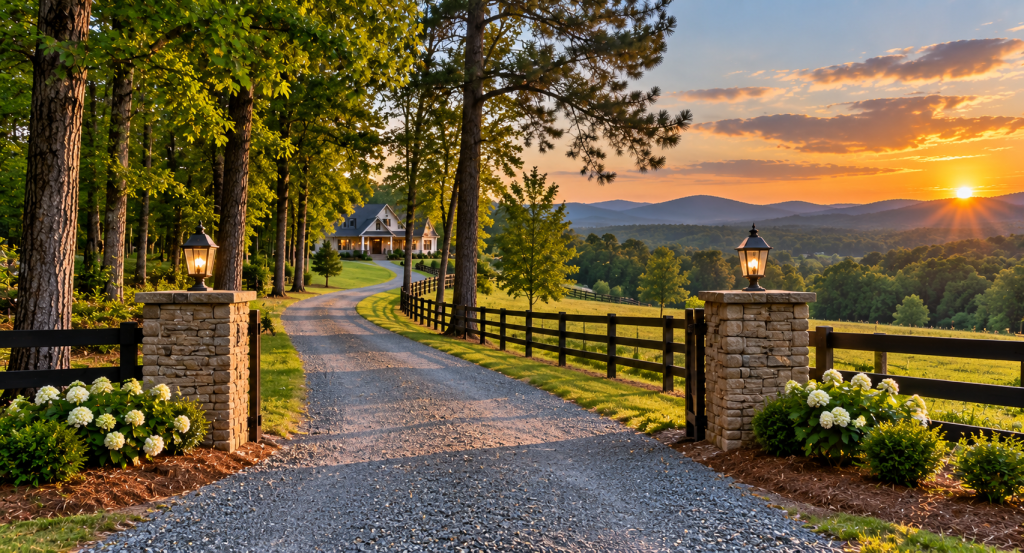
There is a particular kind of real-estate listing photo that gets me every single time.
You know the one.
A long driveway.
Trees on both sides.
You can barely see the house from the road.
Maybe there’s a little curve at the end.
And immediately your brain goes:
YES. Nobody can see me. I have found my people.
😂
I get it.
Privacy is one of the reasons people look at more rural properties in Bartow County in the first place.
But somewhere between:
“Look how private this is!”
and
“We’re writing an offer!”
I need us to talk about that driveway.
Because sometimes a long driveway is simply a long driveway.
And sometimes what looks like a driveway is actually a private road, shared access or easement situation that deserves a little more investigation.
The pretty trees can wait five minutes.
Let’s figure out how we’re getting to the house.
First: Is It Actually Your Driveway?
This sounds ridiculously obvious.
Until it isn’t.
If the driveway runs entirely across the property you’re buying and serves only that house, we’re generally dealing with a much simpler situation.
But rural properties don’t always work that way.
The road or driveway you use to reach the house might:
cross another person’s property,
serve several houses,
follow an access easement,
or be privately maintained by the people who use it.
That’s why I want to know exactly what we’re looking at.
Who owns the land underneath the road?
Who has the legal right to use it?
Who else uses it?
And who is responsible when it needs work?
Suddenly the cute driveway picture has paperwork.
Welcome to real estate. 😂
Private Road and Public Road Are Not the Same Thing
When you live on a normal county-maintained road, you generally don’t spend much time wondering who’s responsible for the road itself.
Private roads can be different.
Bartow County’s road-development rules distinguish private roads from public streets and make clear that private roads are not automatically county-maintained roads. Current county regulations also require private-road signage indicating that the road is not maintained by Bartow County in applicable developments.
For a buyer, the practical question is simple:
If something happens to this road, who fixes it?
Because “not the county” is useful information.
But I would also like to know who does.
Is There a Road Maintenance Agreement?
If multiple property owners use a private road or shared driveway, I want to know whether there is a written agreement addressing maintenance.
Things I want to understand include:
Who pays?
How are costs divided?
Who decides when repairs are necessary?
Who handles routine grading?
What happens if the road washes out?
What about gravel?
Drainage?
Tree removal?
Snow or ice during the approximately four days every five years when Georgia loses its collective mind?
😂
A written maintenance agreement can help spell out those responsibilities.
If there isn’t one, that doesn’t automatically mean the property is a problem.
It means we need to understand the existing arrangement rather than assuming everybody has been happily splitting the gravel bill since 1987.
Easements Matter Here
An easement generally gives someone a legal right to use a portion of property owned by someone else for a specific purpose.
For rural properties, access easements can be especially important.
Imagine finding the perfect house tucked back in the woods.
You own the house.
You own the acreage around it.
But the only way to reach your property crosses someone else’s land.
That doesn’t necessarily mean anything is wrong.
But I absolutely want to know that your legal access is properly established.
Because:
“The neighbor has always let everybody drive through there.”
is not the same sentence as:
“The property has documented legal access.”
And I strongly prefer the second sentence.
😂
We’re going to give easements their own full blog later today because they deserve it.
Drive It Like You Actually Live There
This is one of my favorite pieces of rural-property advice.
Don’t just drive up the driveway once during a sunny afternoon showing.
Look at it.
How steep is it?
How narrow?
Can two vehicles pass?
Is there room to turn around near the house?
What’s the surface?
Asphalt?
Concrete?
Gravel?
Dirt?
What does the drainage look like?
Are there deep ruts?
Washouts?
Low spots?
Overhanging trees?
A tiny bridge or culvert?
Because you’re not just buying the house at the end.
You’re going to use that driveway every single day.
Gravel Is Not Maintenance-Free
A gravel driveway can be perfectly functional.
It can also occasionally require attention.
Traffic, heavy rain and drainage can contribute to potholes, ruts, washboarding and erosion.
A long gravel driveway may eventually need:
grading,
additional gravel,
drainage improvements,
vegetation management,
or repairs after storms.
This doesn’t mean:
DO NOT BUY A HOUSE WITH A GRAVEL DRIVEWAY.
Good Lord. I live in Bartow County. We’d eliminate half the fun. 😂
It means:
Understand what you’re buying.
If the driveway is 900 feet long, maintaining it is a slightly different proposition than maintaining the 30-foot driveway in front of a subdivision house.
Water Is the Enemy
This applies to approximately 73% of things involving houses.
Maybe 84%.
I haven’t conducted the study. 😂
But drainage matters enormously with long driveways and private roads.
Water moving across or alongside a gravel surface can cause erosion and washouts if drainage isn’t properly managed.
So I pay attention to:
ditches,
culverts,
low areas,
slopes,
evidence of previous washouts,
and where stormwater goes after a heavy rain.
And if we’re really interested in the property?
One of the most informative times to see a rural property can be after it rains.
Sunshine makes everything pretty.
Rain occasionally tells on people.
What About Emergency Vehicles?
Here’s something buyers don’t always think about while admiring the privacy.
Can emergency vehicles reasonably reach the house?
Bartow County’s current development standards for private roads address emergency access, including road width and unobstructed vertical clearance requirements in regulated developments.
An existing rural property may have different circumstances depending on when and how it was developed, so I’m not going to pretend one current standard answers every property-specific question.
But the broader issue is absolutely worth considering.
Is the driveway wide enough?
Are tree limbs hanging low?
Is there a gate?
Is the address clearly visible?
Could a fire truck get close enough to the house?
That last one is considerably more important than whether we have room for the Amazon driver to execute a 14-point turn.
Although…
we’re going to discuss him too.
😂
Delivery Trucks Are Coming Down There Too
Because apparently we all order our entire lives from the internet now.
Long driveways affect normal everyday logistics.
Amazon.
UPS.
FedEx.
Furniture deliveries.
Moving trucks.
Propane delivery.
Septic service.
Contractors.
Trash service.
And possibly the delivery of the giant shed your husband bought after saying:
“I’m just looking.”
Sure, sir.
😂
If large vehicles can’t easily turn around near the house, you’ll want to understand how deliveries and service calls typically work.
Don’t Forget School Buses
If you have school-age children, this is another question worth asking.
A school bus may not travel down a private road or driveway simply because houses are located there.
The pickup point may be at the public road.
That can be completely manageable.
But if the house sits a quarter-mile back through the woods, you probably want to know that before the first morning of school.
School transportation routes and stops can change, so verify current information with the appropriate school system for the specific property.
What Happens When a Tree Comes Down?
Welcome to Northwest Georgia.
We have trees.
Lots of them.
And if your beautiful private drive is surrounded by mature trees, eventually Mother Nature may decide:
Nobody is leaving for work today.
A fallen tree across a private driveway or road may become the responsibility of the property owner or the parties responsible for maintaining that private access.
Again, this is where knowing the maintenance arrangement matters.
And if the driveway is your responsibility alone?
Congratulations.
You may eventually discover why rural people own chainsaws.
😂
Internet and Utilities Deserve a Look Too
If a house sits far back from the road, I also want to understand how utilities reach it.
Electric service.
Internet.
Water lines, if applicable.
Gas or propane.
And where applicable, septic and well infrastructure.
A beautiful rural property isn’t nearly as charming when somebody who works remotely discovers their internet options after closing.
That is information we want beforehand.
Your Lender and Insurance Company May Have Questions
Private-road access can sometimes matter beyond the physical condition of the road.
Depending on the property, a lender, title professional or insurer may want documentation involving legal access, easements or maintenance arrangements.
Requirements can vary by property and financing situation.
So if we’re looking at a house accessed by a private road, this is not something I want to discover three days before closing.
We identify it early.
Then the appropriate professionals can determine what documentation is required for that specific transaction.
Questions I Want Answered
If you’re buying a home with a long driveway, shared drive or private road, here’s my working list:
Is the road public or private?
Who owns it?
Who has the legal right to use it?
Is access documented?
Is there an easement?
Is there a written maintenance agreement?
Who pays for repairs?
How is drainage handled?
Can large and emergency vehicles reach the house?
Where is the school-bus pickup?
How do trash and package deliveries work?
What does the road look like after heavy rain?
What utilities serve the property?
And my favorite:
Who owns the tractor?
Because somebody is eventually grading this thing.
😂
A Front Porch Rachel Thought
I completely understand why people fall in love with houses sitting at the end of long driveways.
There’s something wonderful about pulling away from the road, going through the trees and arriving at a place that feels like it’s completely yours.
Privacy.
Quiet.
Room.
No neighbor watching you carry groceries inside wearing pajama pants at 2 PM.
Living the dream.
But rural-property buying is often about looking past the thing that makes you fall in love long enough to understand how it actually works.
That beautiful driveway?
I want you to love it.
I also want to know who owns it, who maintains it and whether you’re going to need a gravel budget.
Because my job isn’t just helping you find the house that makes you say:
“THIS IS IT.”
It’s helping you ask the questions that make you just as happy with that decision after you’ve lived there for a year.
And if we get stuck behind a tractor on the way to the showing?
Consider it part of the Bartow County orientation program.
😂
Real Estate. Real Life. Rachel.
Road ownership, easements, maintenance responsibilities, lending requirements and development standards vary by property. Buyers should verify information for the specific property with the appropriate county departments and qualified legal, lending, title, insurance and other professionals during due diligence.


Leave a comment