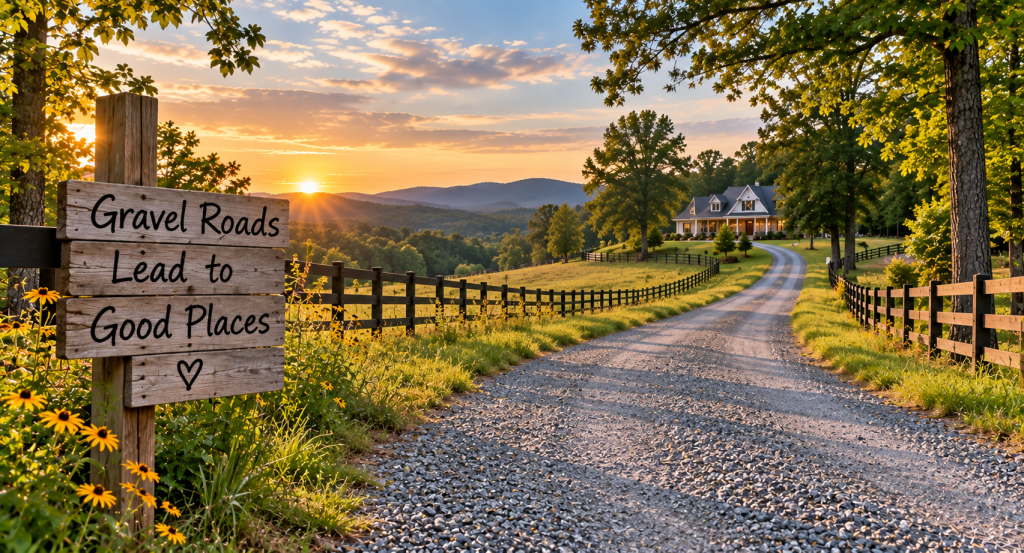
There are two ways to look at a gravel road.
The first is in a real-estate listing.
Trees.
Quiet.
Maybe a little dust floating through the sunlight.
A beautiful house sitting back off the road.
No traffic.
No subdivision entrance.
No neighbor close enough to know whether you’re still wearing pajamas at noon.
Absolutely dreamy.
Then there is the second way to look at a gravel road:
After three straight days of Georgia rain.
😂
Listen.
I live in rural Bartow County.
I love rural Bartow County.
But if you’re considering buying a house on a gravel road, there are some things nobody thinks to ask while they’re standing on the front porch saying:
“Oh my God, it’s so peaceful out here.”
And peaceful it may be.
I just also want you to know what happens when it rains.
First: Not All Gravel Roads Are the Same
This matters.
A gravel road might be:
a county-maintained road,
a private road,
a shared private road,
or something that looks suspiciously like a road but is technically somebody’s very ambitious driveway.
😂
Before buying the property, we need to know which one we’re dealing with.
Bartow County maintains a county road system, but a road’s location inside the county does not automatically mean the county is responsible for maintaining it. The county’s current development regulations separately address private roads and state that private roads in applicable developments are not maintained by Bartow County.
So don’t ask only:
“Is this a gravel road?”
Ask:
“Who maintains this gravel road?”
That is a considerably more useful question.
And yes—we literally just wrote that one today, so Helen is finally linking to something we know exists. 😂
Let’s Talk About Dust
Because nobody puts this in the listing description.
Charming three-bedroom home on peaceful gravel road featuring approximately 14 pounds of complimentary July dust.
😂
Gravel roads can create dust during dry weather, particularly when vehicles travel over them frequently.
How much you’ll notice can depend on things like:
traffic,
weather,
road condition,
how close the house sits to the road,
vegetation,
and the property’s layout.
If the house is sitting 500 feet back through the trees?
You may barely care.
If the front porch is 40 feet from the road?
That’s a different conversation.
Look at:
the siding,
porch,
windows,
vehicles,
and landscaping.
They may tell you how much dust actually reaches the house.
Your Car Is Going to Know Where You Live
If keeping your vehicle perfectly clean is one of your great joys in life…
We should probably have a moment.
😂
Gravel.
Dust.
Mud.
Puddles.
Georgia pollen.
Congratulations.
Your vehicle has entered rural witness protection.
That doesn’t mean your car will constantly be filthy.
It means living on an unpaved road may change how frequently you’re visiting the car wash.
This is not a major real-estate issue.
But it’s definitely a real-life issue.
And around here, those count too.
Rain Changes the Conversation
A gravel road that looks fantastic after a week of dry weather may look different after heavy rain.
Water can contribute to:
potholes,
rutting,
erosion,
washouts,
soft shoulders,
and drainage problems.
The Federal Highway Administration’s guidance for unpaved roads emphasizes drainage as one of the most important factors in gravel-road performance. Good crown, ditches and culverts help move water away from the roadway rather than allowing it to damage the surface.
Translation:
Water is still the enemy.
Apparently this has become a theme in today’s blogs. 😂
When I’m looking at a gravel-road property, I want to notice:
Are there ditches?
Culverts?
Standing water?
Deep potholes?
Evidence of erosion?
Soft areas along the road?
Places where water appears to cross the road?
And if we’re seriously considering the house?
I’d love to see what that road looks like after rain.
Potholes Are Part of the Relationship
If you’ve never lived on a gravel road, you may imagine the road simply stays approximately the way it looked during the showing.
Oh, honey.
😂
Gravel roads are surfaces that require ongoing maintenance.
Traffic and weather can create washboarding and potholes, and maintenance may include grading, adding aggregate and correcting drainage issues.
If it’s county maintained, you’ll want to understand how maintenance concerns are handled.
If it’s private?
Then we circle right back to:
Who pays for this?
Which is why #3 and #6 are cousins but not twins.
What Kind of Vehicle Do You Drive?
No, I’m not saying you need to immediately purchase a lifted F-250 because you moved to Bartow County.
Please do not tell your husband I gave him permission.
😂
Plenty of normal vehicles travel gravel roads perfectly well.
But the actual condition of the road matters.
Ask yourself:
Is it relatively flat?
Steep?
Rutted?
Narrow?
Does it have soft shoulders?
Does it cross low areas?
How long is the unpaved section?
How often is it maintained?
Your cute little sedan may be perfectly happy.
Or you may discover you’re spending significantly more time thinking about ground clearance than you did when you lived in a subdivision.
Winter Weather Gets Interesting
Georgia does not receive endless snowstorms.
What we do occasionally receive is:
one suspicious weather forecast that causes every loaf of bread and gallon of milk within 30 miles to disappear.
😂
But ice is a legitimate consideration on rural roads.
Shaded areas, hills and untreated surfaces may become difficult during winter weather.
If the road leading to your potential home has a significant slope, ask yourself:
What happens if this freezes?
You may decide that’s no big deal.
You work from home.
You have an appropriate vehicle.
You rarely need to leave during bad weather.
Fine.
The goal isn’t to scare you.
It’s to make sure you’ve thought about it.
School Buses Matter Here Too
If you have children, find out where the school bus actually stops.
Don’t assume it comes directly past the house—or down a private section of road.
The pickup point might be at the nearest public road.
Maybe that’s 100 feet away.
Maybe it’s considerably farther.
The current route and stop should be verified directly with the appropriate school system because routes can change.
This is one of those tiny details that becomes considerably less tiny at:
6:47 AM in January.
😂
Packages and Deliveries
Oh, Amazon.
We meet again.
If you’re moving from a subdivision, you’re probably used to a delivery driver pulling directly in front of your house.
Rural delivery can be different.
Depending on the property and road, packages might be:
brought to the house,
left near a gate,
placed in a delivery box,
or handled differently by individual carriers.
And large deliveries deserve extra thought.
Furniture trucks.
Moving trucks.
Appliance delivery.
Dumpsters.
Construction materials.
Can they get down the road?
Can they turn around?
Do they need to back out?
Because nobody wants to discover on moving day that the 26-foot truck containing everything they own has reached a logistical impasse with rural Georgia.
Trash Service May Work Differently Too
This varies by property and service provider, so it’s something to verify rather than assume.
If you’re accustomed to rolling a trash cart 40 feet to the curb every Thursday morning, rural living may introduce you to:
The Long Trash-Can Journey.
😂
Depending on the property, you may use a private collection company, a convenience center or another arrangement.
And if your house sits far back from the road?
Think about where those cans actually need to go.
Suddenly the giant wheeled trash cart makes a lot more sense.
Internet.
Yes.
Again.
Because I am going to beat this drum until every rural homebuyer in Bartow County hears me:
CHECK THE INTERNET BEFORE YOU BUY THE HOUSE.
Do not look at your phone and say:
“I have three bars. We’re good.”
No.
What internet providers service the actual address?
What speeds are available?
Is the service wired?
Fixed wireless?
Satellite?
Fiber?
If you work remotely, stream everything, game online or have teenagers who believe Wi-Fi is a constitutional right…
this matters.
Your Commute Starts Before You Reach the Highway
This is another sneaky one.
Google Maps may tell you the house is:
12 minutes from Cartersville.
Great.
But how much of that drive is the gravel-road portion?
And how does that section feel:
at night,
in rain,
behind a slow vehicle,
during school traffic,
or after a storm?
The road you travel every single day becomes part of your home.
That’s why I want buyers to drive it more than once.
Drive it during the day.
Drive it at night if you’re serious about the property.
Drive the route to work.
Drive to the grocery store.
Don’t just drive from the showing back to Starbucks and call the research complete.
😂
Ask the People Who Already Live There
This is one of the rare circumstances where a neighbor can provide incredibly practical information.
Not:
“Is this a good neighborhood?”
That’s a whole different conversation.
Ask things like:
How often is the road graded?
Does water collect anywhere?
How does it handle heavy rain?
Who maintains it?
Does the road ever wash out?
Where do deliveries normally go?
You’re asking about the road, not requesting the neighborhood gossip report.
Although there’s always a decent chance you’ll receive both.
😂
Look at the Road as Part of the Property
This is the mindset shift I want.
When you’re buying a rural house, the experience of getting to that house matters.
The road isn’t technically part of your kitchen.
But it absolutely becomes part of your daily life.
If you love:
privacy,
quiet,
acreage,
trees,
space between neighbors,
and not hearing somebody else’s leaf blower at 7:13 Saturday morning…
you may happily trade pavement for gravel.
That’s a perfectly reasonable trade.
Just make it knowingly.
A Front Porch Rachel Thought
I think rural living gets romanticized in two completely opposite directions.
One group thinks it’s:
Peace. Quiet. Trees. Deer. Porch coffee.
The other thinks it’s:
Mud. Tractors. Bugs. No internet. Civilization has ended.
😂
The truth is usually somewhere in the middle.
Yes, the road might get dusty.
Yes, your car might stay dirty longer than you’d like.
Yes, occasionally you may find yourself analyzing a pothole with the intensity of a civil engineer.
But you might also pull into your driveway at the end of the day and hear absolutely nothing.
No traffic.
No neighbor six feet away.
No HOA letter because your trash can remained visible for 17 unauthorized minutes.
Just home.
And for some people?
That trade is worth every speck of dust on the Tahoe.
My job isn’t to convince you that rural Bartow County is better.
It’s to make sure you understand what living there actually looks like so you can decide whether it’s better for you.
And if we get stuck behind a tractor while we’re driving out to the showing?
Don’t worry.
Spend enough time looking at rural property with me and eventually we’re probably going to give that tractor a name. 😂
Real Estate. Real Life. Rachel.
Road ownership, maintenance responsibility, school transportation, utility availability and service arrangements vary by location and property. Buyers should verify current information with the appropriate agencies, service providers and qualified professionals during due diligence.


Leave a comment