You’re under contract.
Inspection is behind you.
Financing is moving along.
Everybody is starting to breathe a little easier.
Then your Realtor calls.
The appraisal came in low.
Fantastic.
Exactly the plot twist nobody ordered. 😂
A low appraisal can absolutely create a problem in a real estate transaction.
But it doesn’t automatically mean the deal is dead.
It means we have a number problem.
And number problems usually require us to sit down, look at the contract and figure out what options actually exist.
First: What Does a Low Appraisal Mean?
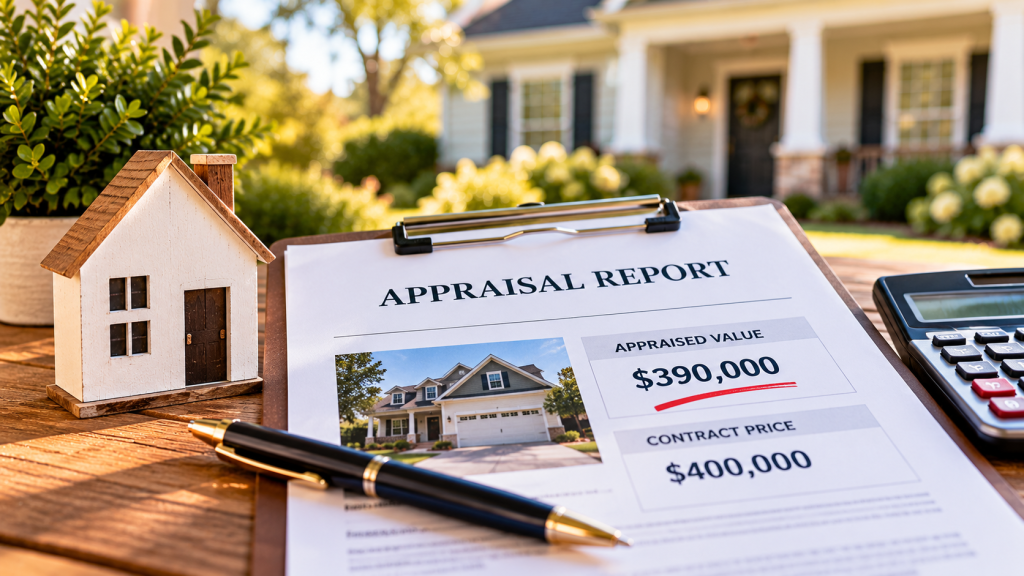
Let’s say a buyer and seller agree to a purchase price of $400,000.
The lender orders an appraisal.
The appraiser determines the property’s value is $390,000.
That’s a $10,000 appraisal gap.
The important thing to understand is that the lender generally isn’t basing the loan on whatever number the buyer and seller agreed to simply because everybody shook hands and signed a contract.
The appraisal helps the lender evaluate the property being used as collateral for the loan.
So now we have:
Contract price: $400,000
Appraised value: $390,000
And a $10,000 problem sitting between them.
Does the Seller Have to Lower the Price?
Not automatically.
This is one of the first questions buyers ask.
“If it didn’t appraise, doesn’t the seller have to reduce the price?”
No.
The seller may agree to lower the price.
But depending on the contract, the seller may have other options too.
Likewise, the buyer doesn’t necessarily have to simply produce the difference without asking questions.
The contract matters.
And if you’ve read more than one of my blogs, you’re probably noticing a theme here.
Real estate has an irritating habit of refusing to give us one universal answer for everything. 😂
Option 1: The Seller Lowers the Purchase Price
This is probably the solution everyone thinks of first.
Using our example:
Contract price: $400,000
Appraisal: $390,000
The seller could agree to reduce the purchase price to $390,000.
Problem solved?
Potentially.
But sellers don’t always want to do that.
They may believe the appraiser missed something.
They may have other interested buyers.
They may not be willing or able to accept less.
So we don’t assume.
We negotiate.
Option 2: The Buyer Covers Some or All of the Difference
A buyer may decide the house is worth more to them than the appraised value.
Maybe inventory is limited.
Maybe the house has a feature that’s hard to find.
Maybe they’ve already competed with several other buyers.
Maybe this is the only house they’ve found with the right location, acreage, layout and a garage large enough for the collection of things their spouse insists are absolutely necessary.
I don’t judge anybody’s garage priorities. 😂
If permitted under the contract and financing structure, the buyer may choose to bring additional funds to closing to cover some or all of an appraisal gap.
But that’s a financial decision—not something a buyer should agree to casually because everyone wants the transaction to keep moving.
Option 3: Buyer and Seller Meet Somewhere in the Middle
This happens too.
Maybe the seller won’t come all the way down.
Maybe the buyer doesn’t want to cover the entire difference.
So they negotiate.
In our $10,000 example, perhaps the seller reduces the price by $5,000 and the buyer handles the remaining gap.
That’s just an illustration—not a rule.
Every transaction has different numbers, motivations and contractual terms.
But sometimes neither side gets exactly what they wanted and everybody still gets to closing.
Welcome to real estate. 😂
Option 4: Review the Appraisal
An appraisal isn’t necessarily something we look at for three seconds and immediately start throwing money around.
We review it.
Were the property details accurate?
Were important features included?
Are there factual errors?
Were the comparable sales reasonable?
Was something significant overlooked?
If there’s legitimate information that may affect the valuation, there may be a process through the lender for requesting a review or reconsideration of value.
That does not mean:
“We don’t like the number, please pick a better one.”
If valuation were that simple, you wouldn’t need me.
You’d need a calculator. 😂
There needs to be relevant information supporting the concern.
And ultimately, the lender and appraisal process control how that request is handled.
Can You Just Order Another Appraisal?
Usually, you don’t simply shop around for appraisals until somebody gives you the number you want.
The appraisal is part of the lender’s process.
If there’s an issue, the buyer needs to work with the lender to understand what options may be available.
Changing lenders simply because you don’t like an appraisal can also create timing and contractual issues.
Again:
Before anybody starts making dramatic moves, look at the contract and talk to the lender.
What About an Appraisal Contingency?
This is where the actual purchase agreement becomes extremely important.
A transaction may include contractual provisions addressing what happens if the property does not appraise at the purchase price.
The buyer’s rights, obligations, deadlines and possible remedies depend on the agreement.
That’s why I don’t love broad internet statements like:
“If the appraisal is low, you can just walk away.”
Maybe.
Maybe not.
Maybe there are specific notices or deadlines that have to be followed.
Maybe the buyer agreed to appraisal-gap language.
Maybe the contract was structured differently.
We don’t make a major decision based on something someone’s cousin posted in a Facebook group.
We pull out the contract.
What Is an Appraisal Gap?
You’ll hear this term frequently, especially in competitive markets.
An appraisal gap is simply the difference between the agreed purchase price and the appraised value.
Sometimes buyers agree in advance to cover a certain amount of that gap.
For example, a buyer might agree—depending on the exact contract language—to contribute up to a specified amount if the appraisal comes in below the purchase price.
That can make an offer more attractive to a seller.
It can also increase the buyer’s financial exposure.
So please understand what you’re agreeing to before using appraisal-gap language simply because somebody told you that’s how you win a house.
Winning the house and regretting the contract are not the same thing.
What Does a Low Appraisal Mean for the Seller?
Sellers don’t love low appraisals either.
Obviously.
But here’s something worth considering:
If the current financed buyer received a low appraisal, simply putting the house back on the market doesn’t guarantee the next appraisal will magically solve everything.
A different appraiser may reach a different conclusion.
A cash buyer may evaluate value differently.
Market conditions may change.
But the seller still needs to consider whether the appraisal revealed a genuine valuation issue.
That’s where we look at:
- Comparable sales
- Current competition
- Recent market activity
- Property condition
- Unique features
- Improvements
- Buyer demand
- How the home was originally priced
A low appraisal doesn’t automatically prove the contract price was wrong.
But it deserves serious evaluation.
Appraisal and Market Value Aren’t Exactly the Same Conversation
This is where real estate gets interesting.
A home’s market value is ultimately influenced by what buyers are willing to pay in the market.
An appraisal is a professional opinion of value prepared for the lender using accepted valuation methods and comparable data.
Those numbers often align.
Sometimes they don’t.
A buyer may willingly pay more than an appraised value because the property is uniquely valuable to them.
That doesn’t necessarily mean the lender is going to finance the difference.
And that’s where the cash-to-close conversation becomes very important.
Should Buyers Panic?
No.
Should sellers panic?
Also no.
Should everybody ignore it and hope the appraisal becomes more cooperative overnight?
Definitely no. 😂
A low appraisal needs to be handled quickly because financing and contract deadlines don’t stop while everyone processes their feelings.
We gather information.
We talk to the lender.
We review the appraisal.
We review the contract.
We determine what each party is willing and able to do.
Then we negotiate.
The Front Porch Take
A low appraisal is a problem.
But it is a problem to solve, not automatically the end of the transaction.
The solution might involve:
- A price reduction
- Additional buyer funds
- A compromise between buyer and seller
- A legitimate appraisal review
- Another solution allowed by the financing and contract
- Or, in some situations, the transaction not moving forward
There isn’t one automatic answer.
And that’s why the most important thing you can do when the appraisal comes in low is resist the urge to immediately panic—or immediately start moving money around.
Read the contract. Understand the numbers. Talk to the lender. Then make the decision.
Because the appraisal may have created a gap.
Our next job is figuring out whether we can build a bridge across it.
Preferably without anybody throwing themselves off the Front Porch first. 😂
Real Estate. Real Life. Rachel.


Leave a Reply