You walk into a house and immediately start noticing the fun stuff.
The kitchen.
The flooring.
The primary bedroom.
The backyard.
Whether your sectional will fit.
Where the Christmas tree is going.
Meanwhile, underneath your feet, one of the most important parts of the entire house is sitting there like:
Hello? Anybody want to ask about me?
😂
I’m talking about the foundation.
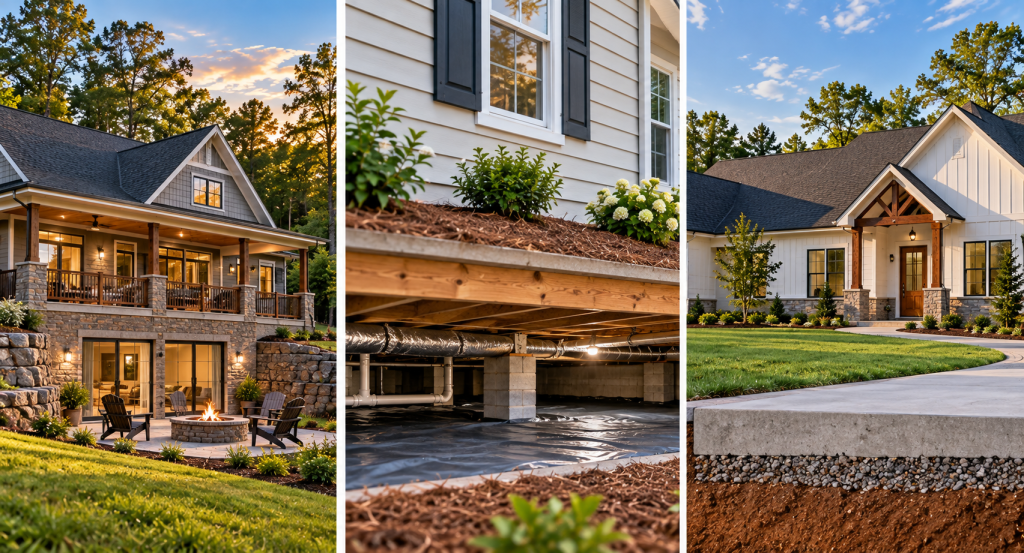
When you’re buying a home in Bartow County, you’ll encounter houses built over basements, crawl spaces and concrete slabs—and sometimes combinations of them.
None of those foundation types automatically makes a house good or bad.
But they each come with different things I want a buyer to understand and inspect.
Because I would much rather talk about the crawl space before you buy the house than discover something interesting growing down there afterward.
First: There Is No Universal “Best” Foundation
Buyers sometimes ask:
“Which is better—a basement, crawl space or slab?”
My Realtor answer is:
Better for what?
A basement may give you valuable additional space.
A crawl space may make certain plumbing, electrical and mechanical components easier to access.
A slab can eliminate the crawl space or basement entirely.
But construction quality, drainage, maintenance, age and the condition of the individual home matter much more than simply checking which foundation box applies.
A beautifully maintained crawl-space home may be a much better purchase than a poorly maintained basement home.
And vice versa.
So we’re not grading foundations.
We’re figuring out what we’re buying.
Let’s Start With Basements
Basements are extremely attractive to a lot of buyers.
And I understand why.
Depending on the house, a basement might provide:
storage,
a workshop,
a home gym,
an office,
a playroom,
an entertainment space,
guest space,
or additional finished living area.
In other words:
A place to put all the stuff you swore you were getting rid of before you moved.
😂
But when I’m walking through a basement with a buyer, I’m not only looking at how we’re going to decorate it.
I’m also looking for clues.
Water and Moisture Deserve Your Attention
This applies to basements and crawl spaces.
Water can enter or affect a foundation area for a variety of reasons, including grading, drainage, gutters, downspouts, groundwater and defects that require professional evaluation.
The U.S. Environmental Protection Agency recommends controlling moisture around foundations by directing water away from the building and maintaining appropriate drainage.
So when we’re looking at a basement, things that may deserve additional investigation include:
water stains,
musty odors,
visible moisture,
efflorescence or mineral deposits,
peeling paint,
dehumidifiers running constantly,
sump pumps,
freshly painted sections of foundation wall,
and evidence of previous repairs.
None of those things automatically tells us:
RUN.
They tell us:
ASK.
There is a difference.
Look Outside Too
Foundation-related due diligence does not stop at the basement door.
I want to look at the exterior.
Where does the land slope?
Where do the gutters discharge?
Are downspouts moving water away from the foundation?
Is water likely to collect near the house?
Are there retaining walls?
Drainage systems?
Low areas?
Because sometimes the most useful information about what’s happening underneath the house starts with what’s happening around it.
And this is another reason I love seeing a property after a good Georgia rain.
Rain is basically a home inspection assistant nobody invited.
😂
Finished Basements Need a Different Kind of Attention
A finished basement can be fantastic.
But drywall, flooring and ceilings also cover things that would otherwise be visible.
So if the basement has been beautifully finished, I want to understand:
Was the work permitted when required?
Were any previous water issues disclosed?
What drainage or waterproofing systems exist?
How is the space heated and cooled?
And if a room is being marketed or used as a bedroom, does it meet applicable requirements for that use?
Don’t assume:
There’s a bed in it = bedroom.
Real estate does not work that way.
Apparently throwing a comforter on something does not create building-code compliance.
Who knew? 😂
Now Let’s Crawl Under the House
Okay.
You don’t necessarily have to.
That’s why God made home inspectors.
😂
But crawl spaces deserve attention because they’re easy for homeowners and buyers to forget.
Out of sight.
Out of mind.
Until something under there becomes very much in mind.
A crawl space may contain plumbing, ductwork, insulation, electrical components and structural elements that can provide important information about the home’s condition.
Inspectors may evaluate things like:
moisture,
standing water,
wood deterioration,
insulation,
ventilation or encapsulation,
pests,
ductwork,
plumbing leaks,
and visible structural components.
This is one of the reasons I am such a believer in professional home inspections.
You can have the prettiest kitchen in Bartow County.
I still want somebody crawling underneath it.
What’s an Encapsulated Crawl Space?
You may see listings advertise an encapsulated crawl space as a feature.
Generally, crawl-space encapsulation involves using a vapor barrier and other moisture-control measures to isolate the crawl space from ground moisture and outside conditions. Depending on the system, dehumidification or other moisture controls may also be used.
The Department of Energy’s Building America guidance discusses sealed and conditioned crawl spaces as one approach to managing moisture and improving building performance when designed and installed appropriately.
That does not mean:
Encapsulated = never inspect it again.
No ma’am.
We’re still looking.
We want to understand the system, its condition and whether it is doing what it’s supposed to do.
What About Slab Foundations?
With a slab foundation, the house is constructed over a concrete slab rather than an accessible crawl space or basement.
There are some obvious differences.
You don’t have a basement to flood.
You don’t have a crawl space for an inspector to crawl into.
But you also don’t have that same below-floor access to certain plumbing or building components.
If plumbing lines are located beneath the slab, for example, repairs can potentially be more involved than repairs to easily accessible plumbing.
Again:
Slab is not bad.
It is simply different.
And we’re going to evaluate the actual house rather than making assumptions based on foundation type.
Cracks: Don’t Diagnose Them Yourself
At some point during a home search, you’re going to see a crack.
Concrete cracks.
Drywall cracks.
Brick cracks.
Foundation walls crack.
And approximately four seconds later someone will say:
“THAT HOUSE HAS FOUNDATION PROBLEMS.”
Maybe.
Maybe not.
Cracks can occur for different reasons, and their significance depends on factors such as location, direction, width, movement and the underlying cause.
This is where we resist the urge to become structural engineers because we watched three TikToks.
😂
If an inspector identifies something concerning, we bring in the appropriate qualified professional—potentially a structural engineer or other specialist—to evaluate it.
My job is not to diagnose the crack.
My job is to make sure we don’t ignore the crack.
Radon Belongs in This Conversation Too
This is something buyers should at least know exists.
Radon is a naturally occurring radioactive gas that can enter homes through openings in floors and foundations. The EPA states that any home can have a radon problem, including homes with or without basements, and recommends testing homes for radon.
So don’t assume:
No basement = no radon concern.
That’s not how it works.
Testing is the way to know the radon level in a particular home.
Don’t Forget Termites and Wood-Destroying Organisms
Welcome to Georgia.
It’s warm.
It’s humid.
The bugs also enjoy living here.
😂
Properties with accessible wood components near the ground deserve appropriate inspection for termites and other wood-destroying organisms.
Moisture can make some conditions more favorable for wood deterioration and pests, which is yet another reason crawl-space moisture deserves attention.
Again, this isn’t:
Crawl space = termites.
It’s:
Georgia house = let’s inspect the damn thing.
The Age of the House Matters
Bartow County has everything from newer construction to homes that have been standing for generations.
A foundation should be evaluated in the context of the house itself.
An older home may show signs of settlement or previous repairs.
A newer home can still have drainage or construction issues.
Age alone doesn’t tell the story.
That’s why I don’t like assumptions such as:
“It’s new construction, so nothing can be wrong.”
or
“It’s 60 years old, so the foundation must be a disaster.”
Neither statement is useful.
We inspect the house in front of us.
What I Want Buyers Asking
Whether the home has a basement, crawl space or slab, I want to know:
Has there ever been water intrusion?
Are there drainage systems or sump pumps?
Have foundation repairs been made?
Are repair records or warranties available?
Are there visible cracks?
Does the property drain away from the house?
Are gutters and downspouts functioning properly?
Is the crawl space damp or dry?
Has it been encapsulated?
Are there signs of pests or wood damage?
Has the home been tested for radon?
Does the inspector recommend additional evaluation?
That’s a much more useful conversation than:
“Basements are better.”
Don’t Let the Pretty Part of the House Distract You
I say this all the time in different ways because it’s one of the biggest challenges of buying a house.
People buy emotionally.
Of course they do.
This is where you’re going to live.
You should be excited.
But the gorgeous kitchen does not get to hypnotize us into forgetting that there’s a foundation underneath it.
The soaking tub doesn’t get to distract us from the water stain.
The screened porch doesn’t erase the questionable drainage.
And the perfect paint color does not repair a structural problem.
We can love the house and still investigate it.
Those two things can happen at the same time.
A Front Porch Rachel Thought
There are two versions of buying a house.
There’s the HGTV version:
LOOK AT THIS KITCHEN.
And then there’s the Rachel version:
LOOK AT THIS KITCHEN.
…
Now where’s the crawl-space access?
😂
Both matter.
I want you to walk into a house and imagine Christmas morning there.
I want you to picture coffee on the porch.
I want you to figure out where the couch goes.
That’s part of finding a home.
But while you’re imagining your life upstairs, I’m going to keep asking questions about what’s happening downstairs.
Because sometimes the least glamorous parts of a house are the ones that deserve the most attention.
Basement, crawl space or slab—we don’t assume.
We inspect. We investigate. And then we make an informed decision.
Real Estate. Real Life. Rachel.
This article provides general homebuyer education and is not structural, engineering, environmental, pest-control or inspection advice. Property conditions vary. Buyers should rely on qualified inspectors and other appropriate professionals to evaluate a specific home.


Leave a comment