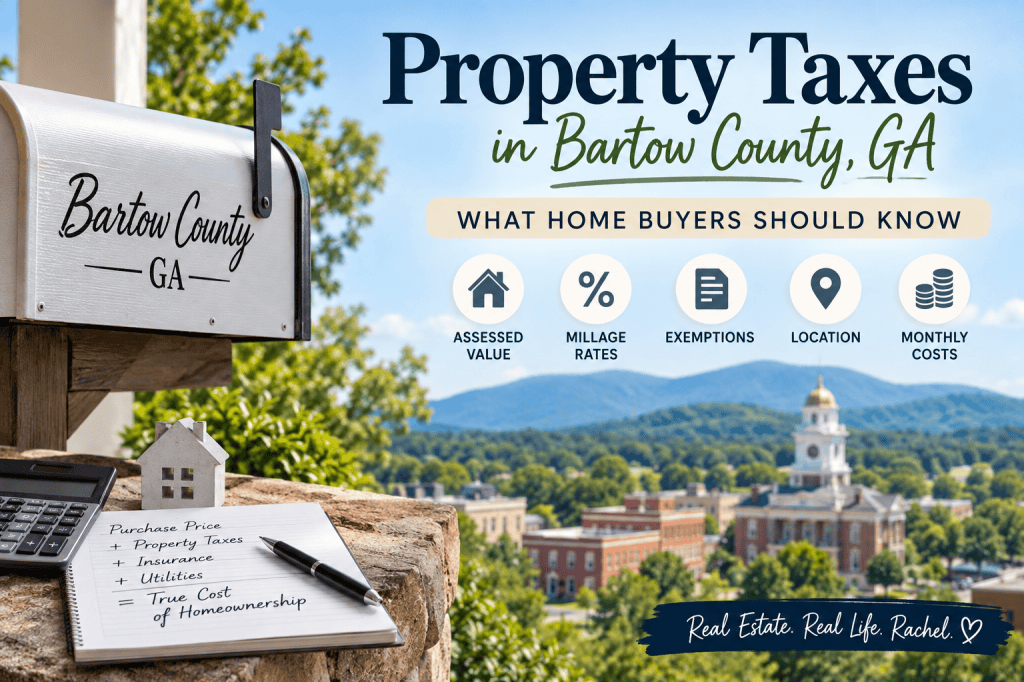
You found the house.
You love the house.
The monthly payment looks manageable.
And then somebody says:
“Don’t forget about property taxes.”
Well, damn. 😂
When you’re figuring out what it actually costs to own a home in Bartow County, the purchase price and mortgage payment aren’t the entire story.
Property taxes can affect your total monthly housing expense, and they’re something I want buyers thinking about before they fall in love with a house—not after.
But property taxes are also one of those subjects where buyers hear a number from a friend or see the previous owner’s tax bill online and assume:
“Perfect. That’s what I’ll pay.”
Not necessarily.
Let’s talk about why.
1. Your Property Tax Bill Isn’t Based Only on the Price You Paid
One of the first things to understand is that your purchase price and the property’s taxable value aren’t necessarily the same number.
Georgia property taxation involves a property’s fair market value, an assessed value, applicable millage rates, and any exemptions for which the owner qualifies.
Which means calculating property taxes isn’t simply:
House price × random percentage = tax bill.
If it were that easy, this would be a much shorter blog. 😂
2. Georgia Uses an Assessed Value for Property Taxes
In Georgia, property is generally assessed for property-tax purposes at 40% of its fair market value, subject to applicable laws and exceptions.
So if a property has a fair market value established by the tax assessor, the taxable calculation begins with the assessed value rather than simply applying millage to the full market value.
Then applicable exemptions and millage rates come into the picture.
This is why I don’t want buyers trying to reverse-engineer their future tax bill from one Zillow screen and a calculator.
3. What in the World Is a Millage Rate?
If you’ve never owned property—or you’ve moved here from somewhere that describes taxes differently—“millage” may sound like something we just made up in Georgia.
We did not. 😂
A millage rate is used to calculate property taxes based on taxable assessed value.
Different taxing authorities can levy taxes, so the total rate affecting a property can involve more than one component.
The important takeaway for a buyer isn’t memorizing the formula.
It’s understanding that location matters.
Two properties with similar prices don’t automatically produce identical property-tax bills.
4. Don’t Assume the Seller’s Current Tax Bill Will Be Yours
THIS ONE MATTERS.
You pull up the tax record.
You see what the current owner paid.
You think:
“Great! Taxes are only $_____ a year.”
Hold up.
The current owner may have exemptions that won’t apply to you.
The property’s assessed value may change.
Ownership changes can affect exemptions.
Other circumstances may affect future bills.
So while the existing tax record is useful information, I would not build your entire home-buying budget around the assumption that your bill will be identical to theirs.
5. Homestead Exemptions Can Matter
If the property will be your primary residence, you may qualify for applicable homestead exemptions.
Eligibility requirements, application procedures and deadlines matter.
And exemptions don’t necessarily transfer from the seller to you simply because you bought the house.
New homeowners need to investigate what they qualify for and how to apply.
This is one of those boring homeowner tasks that is considerably less boring when it potentially affects your money. 😂
6. There May Be Additional Exemptions for Some Homeowners
Depending on individual circumstances and applicable programs, certain homeowners may qualify for additional property-tax exemptions or benefits.
Those can potentially involve factors such as age, disability, veteran status or other eligibility requirements.
I’m deliberately not going to tell you:
“You’ll qualify for this.”
That’s a question for the appropriate taxing authority based on your individual situation.
But I absolutely want buyers to know enough to ask the question.
7. City and County Location Can Matter
Remember how I keep telling you that “Bartow County” isn’t one single place?
Here it is again. 😂
A property located within an incorporated city may have different taxing considerations than a property outside city limits.
That’s another reason why two homes that look similar on paper may have different ownership costs.
When you’re comparing properties in Cartersville, Adairsville, Euharlee, Emerson, Kingston, Taylorsville, White or an unincorporated part of Bartow County, we need to look at the actual property rather than make countywide assumptions.
8. Your Mortgage Payment May Include Property Taxes
Many homeowners pay property taxes through an escrow account associated with their mortgage.
In that situation, part of the monthly mortgage payment goes into escrow, and those funds are later used to pay applicable property taxes.
That’s why I want buyers paying attention to the estimated total monthly payment, not just principal and interest.
A house isn’t affordable because the mortgage portion looks good while we’re ignoring taxes and insurance.
We need the whole number.
9. Property Taxes Can Change
Another thing buyers sometimes assume is:
“Whatever the taxes are today is what they’ll always be.”
Nope.
Property values, assessments, millage rates, exemptions and other factors can change over time.
Your mortgage’s principal-and-interest payment may be relatively predictable with certain fixed-rate loans, but expenses such as property taxes and homeowners insurance can change.
That’s part of homeownership budgeting.
10. What Should You Do Before Buying?
When you’re seriously considering a Bartow County property, don’t guess.
Look up the property’s tax information through the appropriate official sources.
Ask your lender how estimated taxes are being incorporated into your projected payment.
Determine whether the property is inside a municipality.
Learn which exemptions you may qualify for.
And after you buy, make sure you understand any deadlines for applying for those exemptions.
Don’t assume somebody else is going to magically do it for you.
Homeownership comes with keys…
and paperwork. 😂
Why This Matters When Comparing Bartow County Homes
Imagine you’re considering two homes.
Similar purchase price.
Similar size.
Both meet your needs.
But they’re in different locations and have different taxes, insurance costs, utilities or other ongoing expenses.
Suddenly, the comparison isn’t simply:
“Which house costs less?”
It’s:
“What does each house actually cost me to OWN?”
That’s the question I want my buyers asking.
Because the purchase price gets your attention.
The monthly reality determines whether the house comfortably fits your life.
A Front Porch Rachel Thought
When we shop for homes, it’s very easy to focus on the fun stuff.
The kitchen.
The yard.
The bedrooms.
And, obviously, whether there’s a decent front porch. ❤️
But part of my job is helping you look beyond the listing photos.
I want you understanding the expenses that come with the property, asking good questions and making decisions based on more than the number printed beside List Price.
Because buying the house is one thing.
Being comfortable owning it is the goal.
Real Estate. Real Life. Rachel.
This article provides general real estate information and is not tax, legal, lending or financial advice. Property assessments, millage rates, exemptions and tax obligations vary by property and owner and may change. Buyers and homeowners should verify current information with the Bartow County Tax Assessor, Bartow County Tax Commissioner, applicable municipality and appropriate qualified professionals.


Leave a comment